
The practical decisions behind “How to Create a Beginning, Middle, and End in a Presentation”
Good intentions are not enough for “How to Create a Beginning, Middle, and End in a Presentation”; the result depends on how the author handles “Think of three parts as one movement.” Translate the communication goal into an audience action: understand, compare, decide, remember, or perform.
The practical challenge begins when general advice meets real content, real constraints, and a real audience. What question carries the audience from the opening to the conclusion, and why should the answer matter to them? How can context, evidence, tension, examples, and resolution form a coherent path without manipulating or oversimplifying the facts? The sections ahead use these questions to move from the central idea to concrete decisions, technical criteria, and an applied example.
Think of three parts as one movement
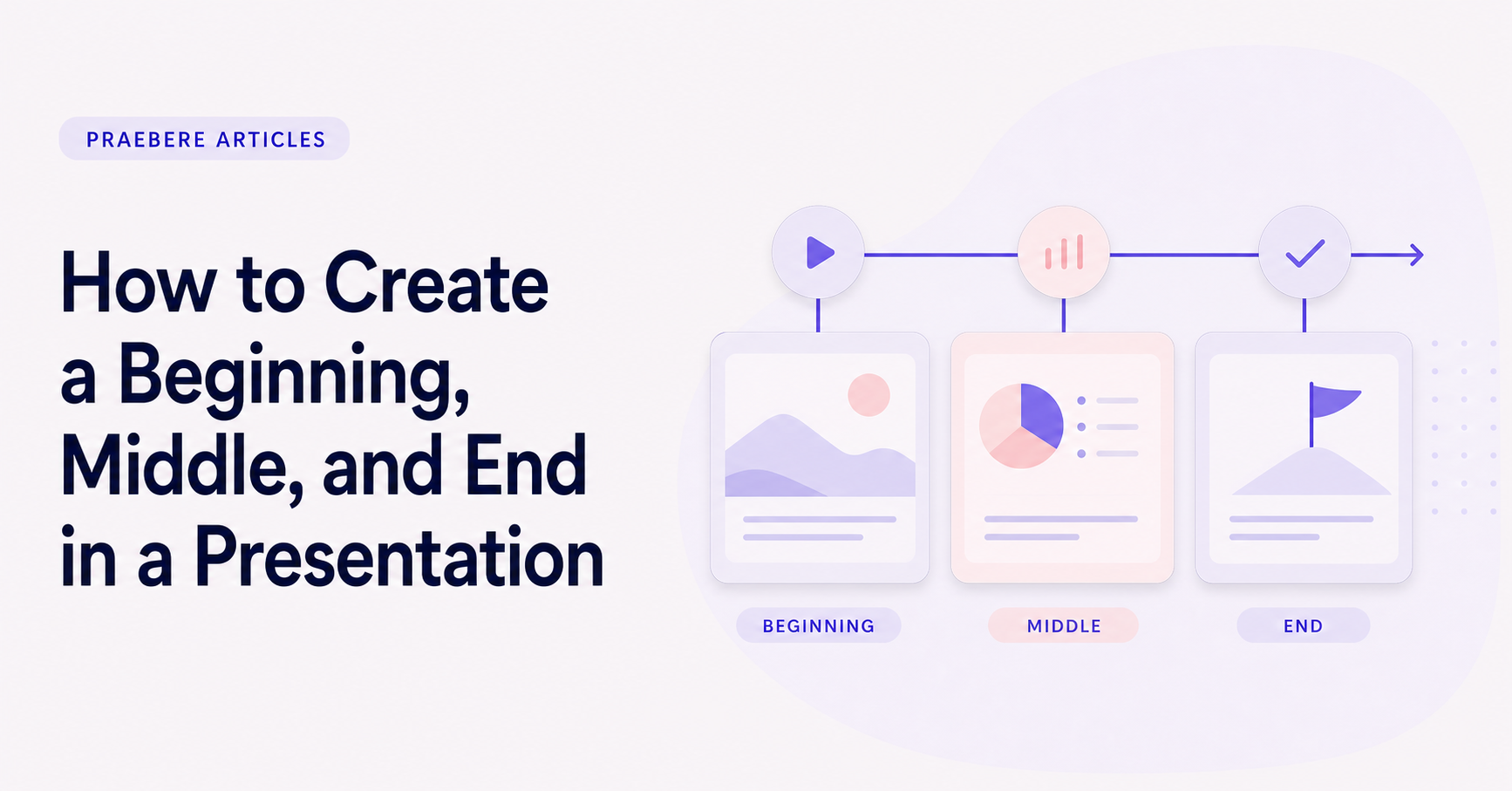
A beginning, middle, and end are not three unrelated sections. The beginning creates a question or expectation, the middle develops the material needed to address it, and the ending resolves it. Each part gains meaning from the others.
Before creating slides, write one line for each part. What situation will the audience enter? What reasoning or change will they experience? What should they understand or do at the end? This small outline exposes gaps before design work begins.
Use the beginning to establish purpose
The opening should orient the audience quickly. Name the subject, explain why it matters now, and make the intended outcome clear. Detailed definitions can wait until the audience understands why they are relevant.
Choose a concrete entry point: a current situation, a short example, a useful contrast, or the central question. Avoid a generic opening that could belong to any presentation. The first section should create a direct path into this specific subject.
- Context the audience needs.
- The central question or problem.
- Why the subject matters now.
- What the presentation will help resolve.
Use the middle to develop, not accumulate
The middle is where presentations often lose direction. Organize it into a small number of stages, each answering a question raised by the previous one. Remove slides that are useful in isolation but do not advance the central line of reasoning.
Alternate between overview and detail when the subject is complex. Show where the audience is in the larger structure, focus on the current section, and reconnect that section to the main argument before moving forward.
Design the ending before polishing the middle
Knowing the ending helps you decide which evidence belongs in the presentation. The conclusion should answer the opening question, state the important takeaway, and identify what happens next. If the ending introduces an entirely new claim, the middle has not prepared it properly.
Avoid ending with a vague “questions” slide as the only conclusion. Invite discussion after the audience has seen the decision, recommendation, or final state. The conversation should begin from a clear position.
Make the three-part structure visible
Use section titles, consistent visual transitions, and recurring landmarks to help the audience recognize progress. A diagram can show the whole journey while the presentation explores one element at a time, preserving both direction and context.
Praebere lets you define that journey directly on a visual board. Sequence the opening context, the connected middle steps, and the final outcome; then add narration or webcam video and preview the camera path before exporting the presentation as video.
Technical implementation notes
Translate the communication goal into an audience action: understand, compare, decide, remember, or perform. Build a claim-evidence-reasoning chain and distinguish observed facts, interpretation, assumptions, uncertainty, and recommendations.
Use progressive disclosure: context first, then the model, evidence, exceptions, and implications. Define unfamiliar terms, keep labels close to what they describe, and test whether a reader can reconstruct the intended logic without the presenter present. The most relevant concepts here are presentation beginning middle end, presentation structure, organize a presentation. Define them when first used and apply each term consistently to an observable element, rule, or outcome.
- Audience and intended action are explicit
- Claims remain connected to evidence
- Assumptions and uncertainty are labeled
- Sequence ends with a clear implication or next step
Worked example: How to Create a Beginning, Middle, and End in a Presentation
Consider a proposal to reduce customer wait time. Open with the current customer journey and measured delay, explain the operational bottleneck, compare two credible interventions, and reveal the recommendation only after the decision criteria and evidence are visible.
Keep observed data separate from interpretation and state the assumptions behind the forecast. The ending should resolve the opening question with an owner, next action, and measure of success, so narrative structure supports a real decision rather than manufacturing suspense.
Conclusion
Taken together, think of three parts as one movement, use the beginning to establish purpose, use the middle to develop, not accumulate, design the ending before polishing the middle, and make the three-part structure visible show that “How to Create a Beginning, Middle, and End in a Presentation” is not an isolated technique. The article connected its central principles to implementation details and a practical case, making the tradeoffs easier to see.
The strongest takeaway, in our opinion, is that storytelling in presentations should clarify the path from context to resolution, not manufacture suspense. Narrative earns its place when it helps the audience understand why the evidence matters and where it leads.
Create the visual journey
Turn your process into a presentation
Build the diagram, choose the sequence, add narration or webcam video, and preview the camera movement in your browser.
Open Praebere