
The practical decisions behind “How to Create an Executive Presentation”
A polished result is only the visible surface of “How to Create an Executive Presentation”; underneath it sits the challenge framed by “Lead with the decision and its significance.” Translate the communication goal into an audience action: understand, compare, decide, remember, or perform.
The practical challenge begins when general advice meets real content, real constraints, and a real audience. What precise decision does the audience need to make, and which evidence, uncertainty, tradeoffs, and consequences belong in that decision? Can leaders identify the requested action, owner, deadline, and conditions that would change the recommendation? The sections ahead use these questions to move from the central idea to concrete decisions, technical criteria, and an applied example.
Lead with the decision and its significance
State what changed, why it matters now, and what you need from the audience. Executives should not have to infer the request after ten slides of background.
Organize supporting material around outcomes, evidence, options, risk, and recommendation. Move detailed methods and backup tables to an appendix.
Make every conclusion actionable
Use comparable scales, named sources, visible assumptions, and a limited number of meaningful measures. Separate actuals, forecasts, and targets so confidence is not overstated.
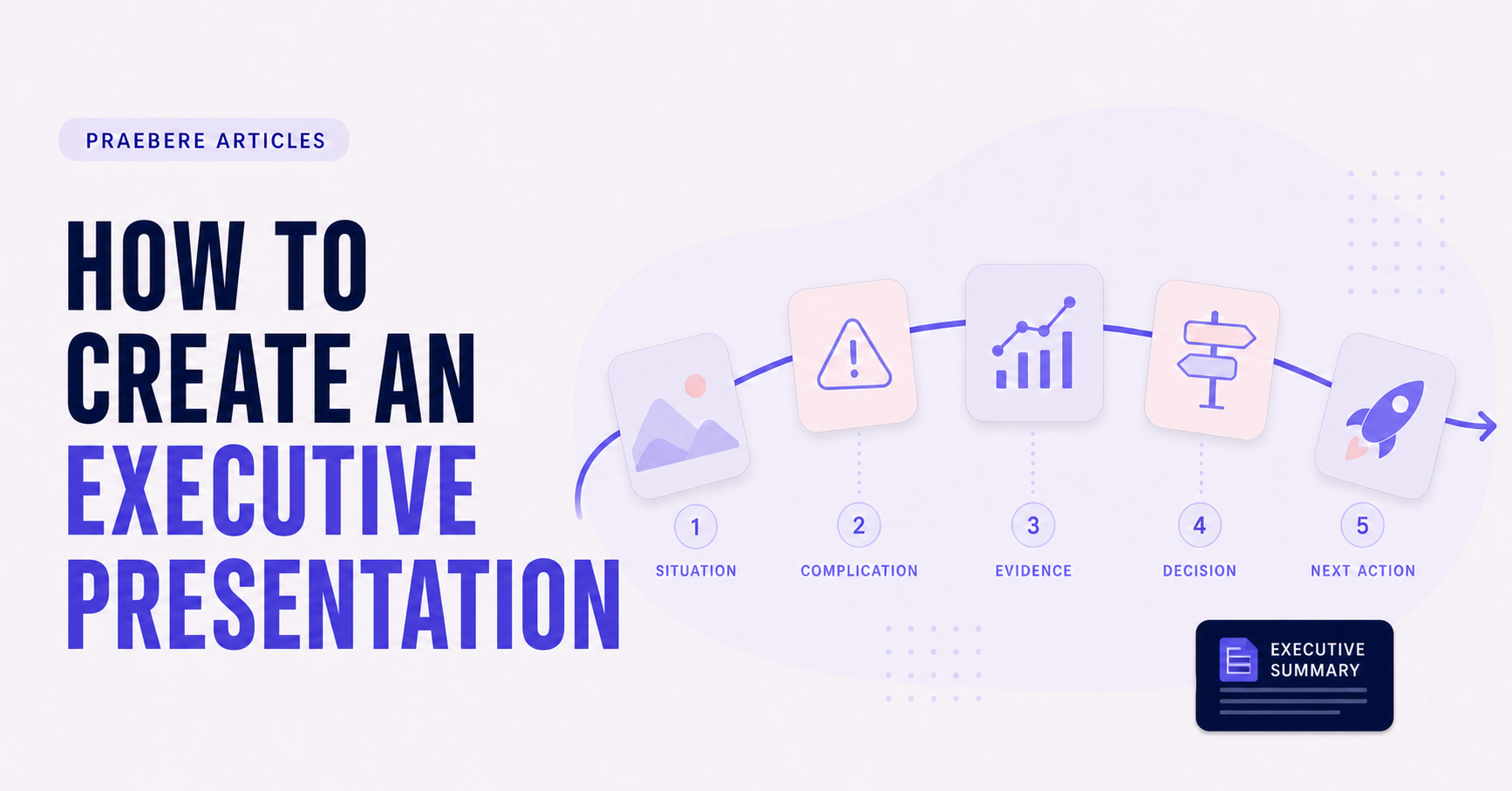
Close with decision owners, dates, dependencies, and the consequence of delay. A Praebere sequence can guide attention through the argument while the author controls every claim.
Prepare an evidence package behind the concise story
The main presentation can be short only when the evidence behind it is organized. Create an appendix with definitions, sources, methods, assumptions, segment detail, scenarios, financial model, risk register, and answers to likely questions. Number key claims so reviewers can trace them quickly instead of searching through backup slides.
Rehearse the decision path at multiple durations: a one-minute summary, a five-minute recommendation, and the full discussion. Anticipate what would change the recommendation and state it. Verify confidential markings and distribution permissions, and create a written record of decisions, conditions, owners, and follow-up dates after the meeting.
- Put the decision, impact, and ask near the beginning
- Keep material evidence traceable in an appendix
- Prepare alternatives and the conditions that favor each one
- Record the resulting decision and accountability
Technical implementation notes
Translate the communication goal into an audience action: understand, compare, decide, remember, or perform. Build a claim-evidence-reasoning chain and distinguish observed facts, interpretation, assumptions, uncertainty, and recommendations.
Use progressive disclosure: context first, then the model, evidence, exceptions, and implications. Define unfamiliar terms, keep labels close to what they describe, and test whether a reader can reconstruct the intended logic without the presenter present. The most relevant concepts here are executive presentation, presentation for executives, leadership slides. Define them when first used and apply each term consistently to an observable element, rule, or outcome.
- Audience and intended action are explicit
- Claims remain connected to evidence
- Assumptions and uncertainty are labeled
- Sequence ends with a clear implication or next step
Worked example: How to Create an Executive Presentation
Suppose leadership must decide whether to fund a service expansion. Begin with the decision and strategic objective, then show the current baseline, expected range rather than a single-point promise, resource requirement, major dependencies, and comparable downside scenarios.
Separate committed results from forecasts, assign an owner to each risk response, and define the trigger that would change the recommendation. End with a precise ask—amount, authority, deadline, and next review—so the presentation can produce an accountable decision.
Conclusion
The path through lead with the decision and its significance, make every conclusion actionable, and prepare an evidence package behind the concise story brings the article back to one practical concern: how “How to Create an Executive Presentation” behaves outside an ideal example. The technical checks and worked scenario turn the guidance into something a reader can evaluate and apply.
Our editorial position is straightforward: business communication should connect evidence and uncertainty to a decision, owner, and next action. Concision is useful only when it preserves the context required to act responsibly.
Create the visual journey
Turn your process into a presentation
Build the diagram, choose the sequence, add narration or webcam video, and preview the camera movement in your browser.
Open Praebere