
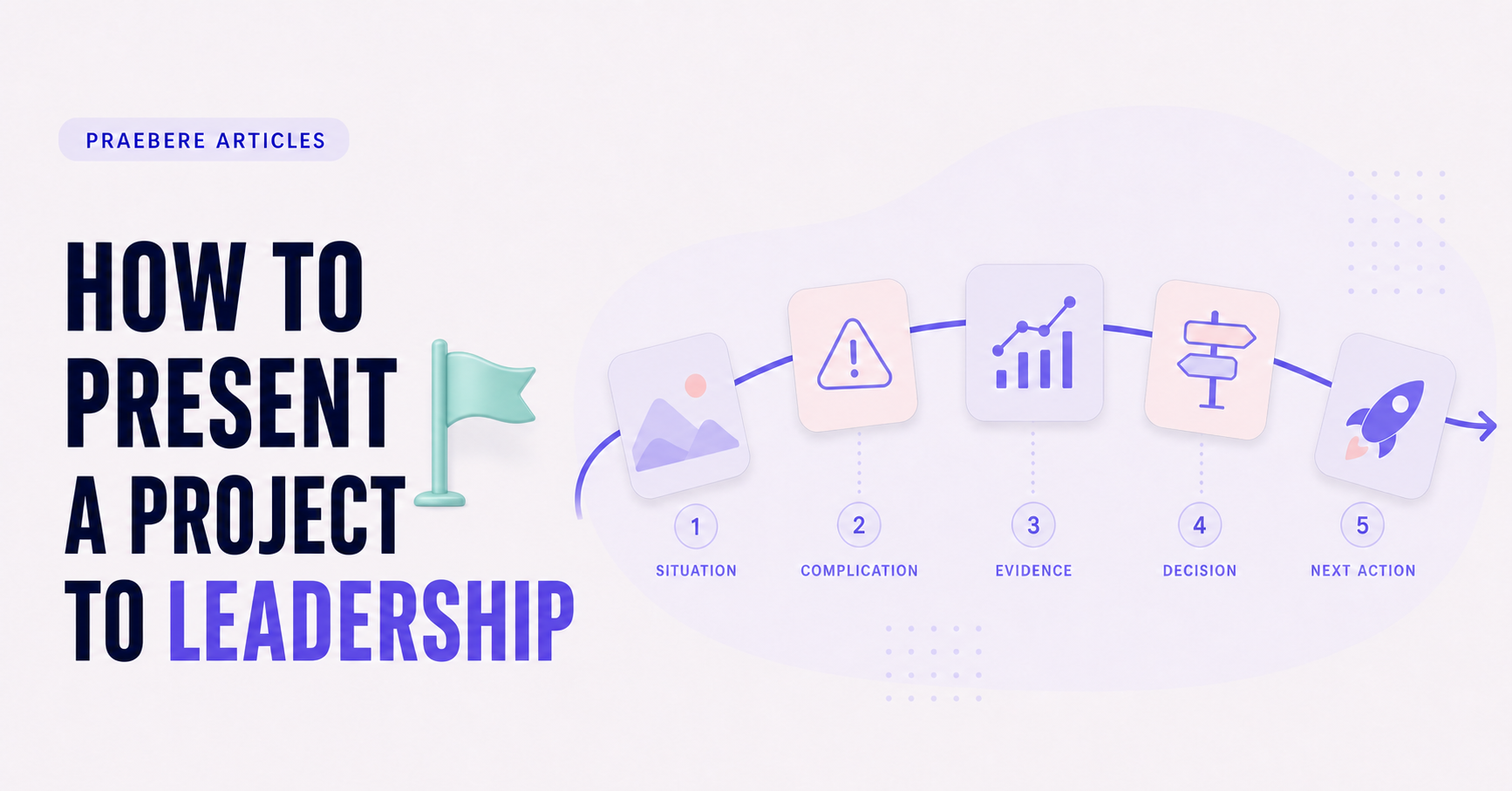
The practical decisions behind “How to Present a Project to Leadership”
Real constraints reveal what “How to Present a Project to Leadership” demands, beginning with the issue in “Connect the project to a strategic outcome.” Translate the communication goal into an audience action: understand, compare, decide, remember, or perform.
The practical challenge begins when general advice meets real content, real constraints, and a real audience. What precise decision does the audience need to make, and which evidence, uncertainty, tradeoffs, and consequences belong in that decision? Can leaders identify the requested action, owner, deadline, and conditions that would change the recommendation? The sections ahead use these questions to move from the central idea to concrete decisions, technical criteria, and an applied example.
Connect the project to a strategic outcome
Explain the problem, affected people, measurable outcome, and why action is timely. Describe scope and exclusions before discussing features or task lists.
Show evidence that the project can change the outcome: discovery, pilot results, dependencies, cost ranges, or comparable work. Mark assumptions explicitly.
Make the leadership decision precise
Present credible options and tradeoffs, including the consequences of doing nothing. Summarize schedule, resources, risks, decision gates, and accountable leadership sponsor.
End with one clear ask—approval, funding, priority, staffing, or escalation—and specify when the next decision will occur.
Define stage gates, benefits, and stopping rules
Break a large commitment into evidence-producing stages. For each gate, state deliverables, cost and time range, success measure, unresolved risk, and the decision to continue, change, pause, or stop. This gives leadership meaningful control without asking them to approve every implementation detail.
Create a benefits map from project outputs to changed behavior, operational capability, and business outcome. Name the owner responsible for realizing each benefit after delivery. Include adoption, training, migration, support, decommissioning, and recurring operating cost; a project that ships software but does not change the target outcome is not complete.
- Separate output delivery from benefit realization
- Use stage gates to buy evidence before larger commitment
- Include total lifecycle cost and organizational change
- Define success, stopping rules, sponsor, and benefit owners
Technical implementation notes
Translate the communication goal into an audience action: understand, compare, decide, remember, or perform. Build a claim-evidence-reasoning chain and distinguish observed facts, interpretation, assumptions, uncertainty, and recommendations.
Use progressive disclosure: context first, then the model, evidence, exceptions, and implications. Define unfamiliar terms, keep labels close to what they describe, and test whether a reader can reconstruct the intended logic without the presenter present. The most relevant concepts here are project presentation to leadership, leadership project update, project proposal presentation. Define them when first used and apply each term consistently to an observable element, rule, or outcome.
- Audience and intended action are explicit
- Claims remain connected to evidence
- Assumptions and uncertainty are labeled
- Sequence ends with a clear implication or next step
Worked example: How to Present a Project to Leadership
Suppose leadership must decide whether to fund a service expansion. Begin with the decision and strategic objective, then show the current baseline, expected range rather than a single-point promise, resource requirement, major dependencies, and comparable downside scenarios.
Separate committed results from forecasts, assign an owner to each risk response, and define the trigger that would change the recommendation. End with a precise ask—amount, authority, deadline, and next review—so the presentation can produce an accountable decision.
Conclusion
The article’s main threads—connect the project to a strategic outcome, make the leadership decision precise, and define stage gates, benefits, and stopping rules—lead to a shared lesson: the quality of “How to Present a Project to Leadership” can be tested. Technical criteria and a realistic example make strengths, omissions, and consequences visible.
The strongest takeaway, in our opinion, is that business communication should connect evidence and uncertainty to a decision, owner, and next action. Concision is useful only when it preserves the context required to act responsibly.
Create the visual journey
Turn your process into a presentation
Build the diagram, choose the sequence, add narration or webcam video, and preview the camera movement in your browser.
Open Praebere