
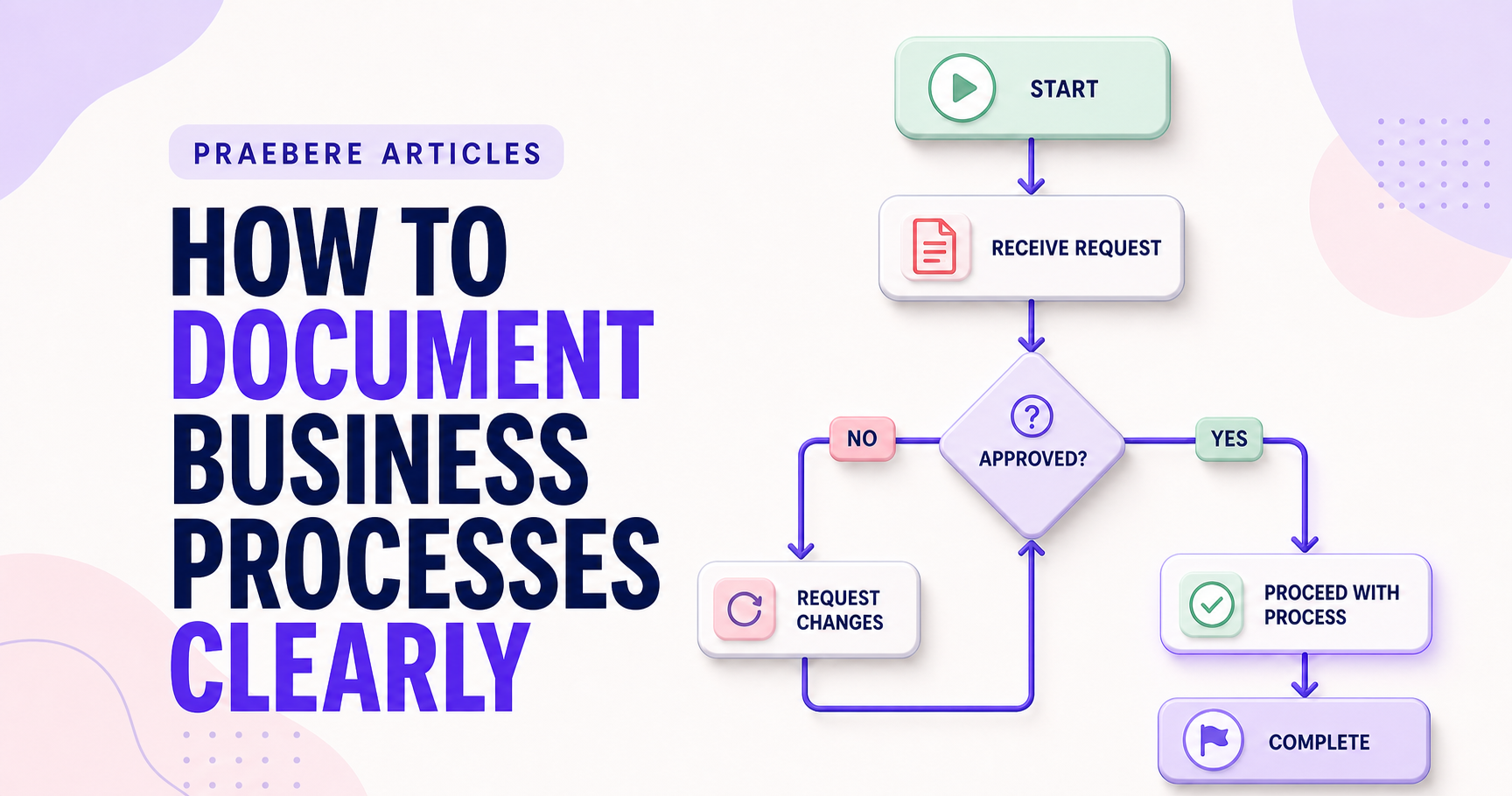
The practical decisions behind “How to Document Business Processes Clearly”
A reader can understand “How to Document Business Processes Clearly” more clearly by first looking at “Define why the process is being documented.” A process model needs an explicit scope, start and end events, actors, inputs, outputs, decisions, exceptions, and ownership.
The practical challenge begins when general advice meets real content, real constraints, and a real audience. Where does the process truly begin and end, who owns each handoff, and what happens outside the ideal path? Could a new participant follow the decisions and exceptions without relying on undocumented knowledge? The sections ahead use these questions to move from the central idea to concrete decisions, technical criteria, and an applied example.
Define why the process is being documented
Documentation for onboarding, compliance, improvement, automation, and incident response requires different levels of detail. State the audience, process owner, trigger, expected outcome, and boundaries before collecting steps.
Record the version, review date, and source of approval. Process documentation becomes risky when readers cannot tell whether it reflects current practice.
Document the real workflow, not only the intended policy
Interview the people who perform and receive the work. Observe handoffs, tools, waiting periods, decisions, inputs, outputs, and common exceptions. Compare these findings with existing policies and system records.
Separate current state from proposed improvements. Combining them in one unlabeled diagram can make people believe a future design is already operational.
Combine a visual overview with supporting detail
Use a process map to show sequence, ownership, and branches. Keep instructions, evidence requirements, forms, definitions, and system details in accompanying text or linked resources so the diagram remains readable.
Give every decision an owner and clear criteria. Identify inputs and outputs at important handoffs, and use the same names for roles and systems throughout the documentation.
Validate, publish, and maintain the process
Walk through real scenarios with participants and test every path. Assign responsibility for updates and define events that trigger a review, such as a policy change, system migration, audit finding, or recurring error.
Praebere can turn the approved visual process into a narrated video for onboarding or internal communication. Keep the editable diagram as the maintained source so future changes can be updated without rebuilding the whole explanation from the beginning.
Technical implementation notes
A process model needs an explicit scope, start and end events, actors, inputs, outputs, decisions, exceptions, and ownership. Use consistent symbols and verb-led activity labels, and separate the normal path from failures, retries, escalations, and manual review.
Validate the model by walking through real cases with the people who perform the work. Record assumptions, system boundaries, rule sources, version, owner, and review date so the diagram remains traceable instead of becoming an attractive but stale picture. The most relevant concepts here are business process documentation, document workflows, process mapping guide. Define them when first used and apply each term consistently to an observable element, rule, or outcome.
- Every branch has a labeled condition
- Activities identify an action and responsible actor
- Exceptions and handoffs are visible
- The model has an owner and review trigger
Worked example: How to Document Business Processes Clearly
Take a purchase request that begins with employee submission and ends with approval, rejection, or revision. Identify the requester, manager, finance team, and system; label the decision thresholds; and add branches for missing receipts, budget exceptions, duplicate requests, and timeout escalation.
Walk through a routine request and two edge cases with process owners. If participants disagree about a branch, record the governing rule and owner instead of choosing the visually simplest route. The corrected diagram can then become the sequence for a narrated presentation.
Conclusion
Rather than reducing “How to Document Business Processes Clearly” to a checklist, the article linked define why the process is being documented, document the real workflow, not only the intended policy, combine a visual overview with supporting detail, and validate, publish, and maintain the process. That combination explains not only what to do, but also why the choices matter and how to inspect the outcome.
The strongest takeaway, in our opinion, is that a process visual becomes trustworthy only when it includes real decisions, responsibilities, handoffs, exceptions, and outcomes. The neatest diagram is not necessarily the most truthful one.
Create the visual journey
Turn your process into a presentation
Build the diagram, choose the sequence, add narration or webcam video, and preview the camera movement in your browser.
Open Praebere