
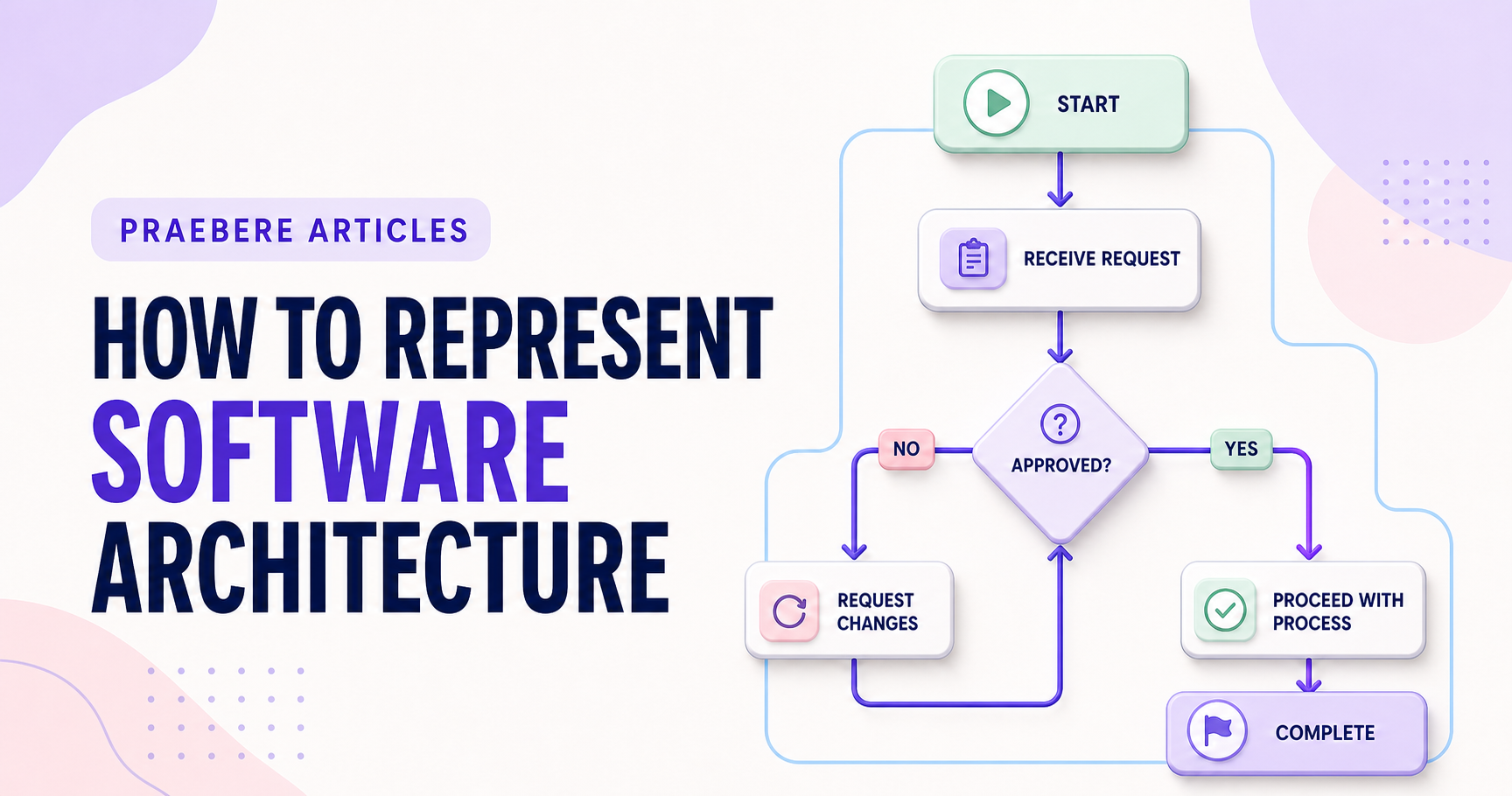
The practical decisions behind “How to Represent Software Architecture”
One issue sets the direction for “How to Represent Software Architecture”: “Give every view a question to answer.” Choose a view for a specific architectural question.
The practical challenge begins when general advice meets real content, real constraints, and a real audience. Which architectural question must the visual answer, and what level of detail belongs in that view? How can boundaries, runtime behavior, failures, and source-of-truth documentation remain connected without turning the diagram into an unreadable inventory? The sections ahead use these questions to move from the central idea to concrete decisions, technical criteria, and an applied example.
Give every view a question to answer
Start with the audience and decision. A context view explains the system and its external relationships; a container or component view reveals responsibilities; a deployment view shows runtime infrastructure.
Do not place every detail in one picture. Use consistent boundaries, labels, direction, and a legend, then connect views through stable names.
Record meaning beyond the boxes
Label relationships with their purpose and, when useful, protocol or data. Document security boundaries, ownership, critical dependencies, failure domains, and architectural decisions that the diagram alone cannot explain.
Keep diagrams near the source they describe and review them when the system changes. Praebere can turn an architecture walkthrough into a sequenced visual presentation, but it is not an architecture validator.
Connect structure to quality attributes and decisions
Architecture is shaped by required qualities such as availability, security, performance, scalability, maintainability, privacy, and cost. Add scenarios that make those qualities testable: which user performs what action, under what load or failure, and with what expected response. Then show the components and boundaries responsible for achieving that outcome.
Record major choices in architecture decision records with context, options, decision, consequences, and status. A diagram shows the current structure, while decision records explain why it exists. Include trust boundaries, data classification, ownership, external dependencies, and failure propagation, and distinguish the logical view from the physical deployment used in each environment.
- Tie diagrams to measurable quality-attribute scenarios
- Show trust, data, ownership, and failure boundaries
- Keep logical and deployment views distinct
- Link important elements to architecture decision records
Technical implementation notes
Choose a view for a specific architectural question. Document boundaries, responsibilities, interfaces, data ownership, trust zones, deployment, runtime communication, and failure propagation without mixing every abstraction level into one diagram.
Link the explanatory view to authoritative artifacts such as source repositories, API contracts, infrastructure definitions, decision records, and observability data. Add owner, version, scope, assumptions, and review triggers so readers can judge currency and confidence. The most relevant concepts here are software architecture diagram, represent software architecture, system diagram. Define them when first used and apply each term consistently to an observable element, rule, or outcome.
- Viewpoint and abstraction level are named
- Dependencies show direction and protocol
- Data and trust boundaries are visible
- Diagram links to current technical sources
Worked example: How to Represent Software Architecture
Consider an online checkout that calls an API gateway, order service, payment provider, inventory service, and message queue. Start with a context view for business stakeholders, then add a container or component view for ownership and a sequence view for the successful request plus timeout and retry paths.
Label protocols, synchronous and asynchronous calls, data ownership, authentication boundary, timeout, retry limit, and responsible team. Link the API interaction to the OpenAPI contract and the deployment view to infrastructure definitions so the explanation can be checked against the running system.
Conclusion
Seen as a whole, the sections on give every view a question to answer, record meaning beyond the boxes, and connect structure to quality attributes and decisions move from explanation to application. They show that “How to Represent Software Architecture” depends on both a clear concept and disciplined execution.
Our judgment after considering the full article is that an architecture visual earns trust through a clear viewpoint, explicit boundaries, traceable sources, and regular maintenance. Showing fewer current and relevant details is better than publishing an exhaustive diagram that no longer matches the system.
Create the visual journey
Turn your process into a presentation
Build the diagram, choose the sequence, add narration or webcam video, and preview the camera movement in your browser.
Open Praebere