
The right choice depends on the job
Good intentions are not enough for “Definition of Done vs. Acceptance Criteria”; the result depends on how the author handles “They describe different scopes of completion.” A process model needs an explicit scope, start and end events, actors, inputs, outputs, decisions, exceptions, and ownership.
The practical challenge begins when general advice meets real content, real constraints, and a real audience. Which Scrum element is being inspected, what commitment gives it purpose, and what evidence should cause the team to adapt? Is the practice supporting transparency and self-management, or has it become a reporting ritual disconnected from product value? The sections ahead use these questions to move from the central idea to concrete decisions, technical criteria, and an applied example.
They describe different scopes of completion
The Definition of Done is a formal description of the state of the Increment when it meets the quality measures required for the product. It applies consistently to Increment work and creates a shared understanding of what “Done” means.
Acceptance criteria usually describe conditions for one Product Backlog item or product behavior. They are a useful complementary practice, but the Scrum Guide does not define them as a Scrum artifact or commitment.
The Definition of Done protects product-level quality
A Definition of Done can include testing, integration, review, security, documentation, accessibility, deployment readiness, or organizational standards appropriate to the product. If an item does not meet it, that work cannot be considered part of the Increment.
Developers are required to conform to the Definition of Done. When multiple Scrum Teams work on one product, they must use a shared Definition of Done that makes the combined Increment transparent.
- Applies across Increment work.
- Expresses required product quality.
- Creates transparency about usable completion.
- Can become more stringent as capability improves.
Acceptance criteria clarify item-specific expectations
Acceptance criteria can describe scenarios, business rules, boundaries, examples, and observable outcomes for a particular item. They support conversation among the Product Owner, Developers, stakeholders, and specialists before and during development.
Meeting acceptance criteria does not override the Definition of Done. A feature may behave as requested while lacking required integration, security review, documentation, or other product-wide quality measures.
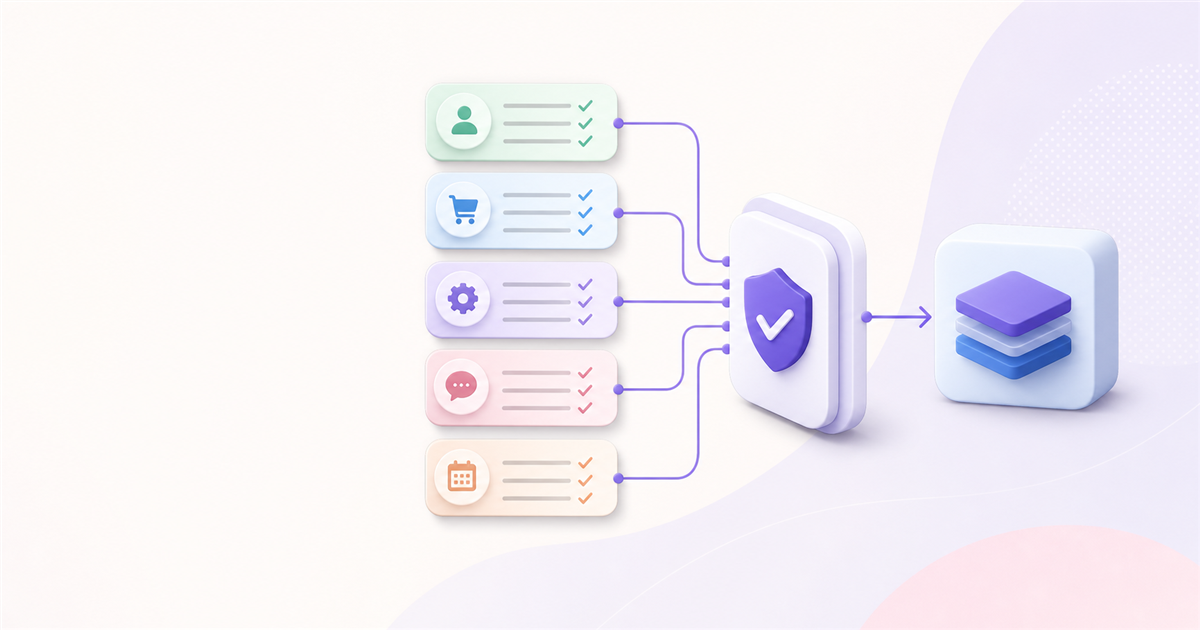
Use a layered visual model to prevent confusion
Place item-specific conditions inside each work item and show the Definition of Done as a shared quality gate around the Increment. The model makes it clear that every completed item must satisfy its relevant expectations and the common product standard.
Review both when work or risks change. Acceptance criteria can evolve through conversation, while changes to the Definition of Done affect transparency and capability across the product.
Technical implementation notes
A process model needs an explicit scope, start and end events, actors, inputs, outputs, decisions, exceptions, and ownership. Use consistent symbols and verb-led activity labels, and separate the normal path from failures, retries, escalations, and manual review.
Validate the model by walking through real cases with the people who perform the work. Record assumptions, system boundaries, rule sources, version, owner, and review date so the diagram remains traceable instead of becoming an attractive but stale picture. The most relevant concepts here are Definition of Done vs acceptance criteria, Scrum quality, acceptance criteria examples. Define them when first used and apply each term consistently to an observable element, rule, or outcome.
- Every branch has a labeled condition
- Activities identify an action and responsible actor
- Exceptions and handoffs are visible
- The model has an owner and review trigger
Worked example: Definition of Done vs. Acceptance Criteria
Consider a Scrum Team improving account recovery. Connect the Product Goal to a Sprint Goal focused on reducing failed recovery attempts, select a small set of Product Backlog items, and make the Definition of Done visible beside the usable Increment rather than treating completion as a ticket status.
During the Sprint, inspect progress toward the goal, adapt the Sprint Backlog when an integration risk appears, and bring measured recovery results to the Sprint Review. Use the Retrospective to choose one owned improvement to the team's testing workflow, then show how that adaptation enters the next Sprint.
Conclusion
Taken together, they describe different scopes of completion, the definition of done protects product-level quality, acceptance criteria clarify item-specific expectations, and use a layered visual model to prevent confusion show that “Definition of Done vs. Acceptance Criteria” is not an isolated technique. The article connected its central principles to implementation details and a practical case, making the tradeoffs easier to see.
We believe the practical standard should be clear: Scrum works through transparent goals, usable Increments, frequent inspection, and real adaptation—not through mechanically scheduling meetings or enforcing optional practices as rules. A visual model should preserve those feedback loops and the self-management on which they depend.
Create the visual journey
Turn your process into a presentation
Build the diagram, choose the sequence, add narration or webcam video, and preview the camera movement in your browser.
Open Praebere