
The definition is only the starting point
A polished result is only the visible surface of “What Is Scrum A Visual Guide to the Framework”; underneath it sits the challenge framed by “Scrum is a lightweight framework for complex work.” A process model needs an explicit scope, start and end events, actors, inputs, outputs, decisions, exceptions, and ownership.
The practical challenge begins when general advice meets real content, real constraints, and a real audience. Which Scrum element is being inspected, what commitment gives it purpose, and what evidence should cause the team to adapt? Is the practice supporting transparency and self-management, or has it become a reporting ritual disconnected from product value? The sections ahead use these questions to move from the central idea to concrete decisions, technical criteria, and an applied example.
Scrum is a lightweight framework for complex work
Scrum helps people generate value through adaptive solutions to complex problems. It establishes a small set of accountabilities, events, artifacts, commitments, and rules while leaving teams responsible for the practices they use to perform the work.
That distinction matters. Scrum does not prescribe user stories, story points, planning poker, software tools, or a particular engineering method. Teams can use compatible practices, but they should not confuse common additions with requirements of the framework.
Transparency, inspection, and adaptation form the engine
Scrum is founded on empiricism: decisions are based on what is observed and learned. Transparency makes important work and outcomes visible, inspection identifies differences or new information, and adaptation changes the plan before the gap becomes more costly.
The five Scrum values—commitment, focus, openness, respect, and courage—support the behavior needed for this cycle. Without truthful information and permission to adapt, the events can become ceremonies that produce activity without learning.
- Transparency exposes work, quality, goals, and outcomes.
- Inspection compares evidence with the current goal.
- Adaptation changes the product or plan when learning requires it.
- Scrum values influence how people use the framework.
One Scrum Team contains three accountabilities
The Product Owner is accountable for maximizing product value and effective Product Backlog management. The Scrum Master is accountable for establishing Scrum and improving the Scrum Team’s effectiveness. Developers are accountable for creating a usable Increment every Sprint.
The Scrum Guide uses “accountabilities” rather than traditional job-role boundaries. The team is cross-functional and self-managing: members collectively possess the skills needed to create value and decide internally who does what, when, and how.
Events inspect artifacts and adapt commitments
The Sprint contains Sprint Planning, Daily Scrums, Sprint Review, and Sprint Retrospective. The Product Backlog, Sprint Backlog, and Increment make work and value transparent; each has a commitment: Product Goal, Sprint Goal, and Definition of Done.
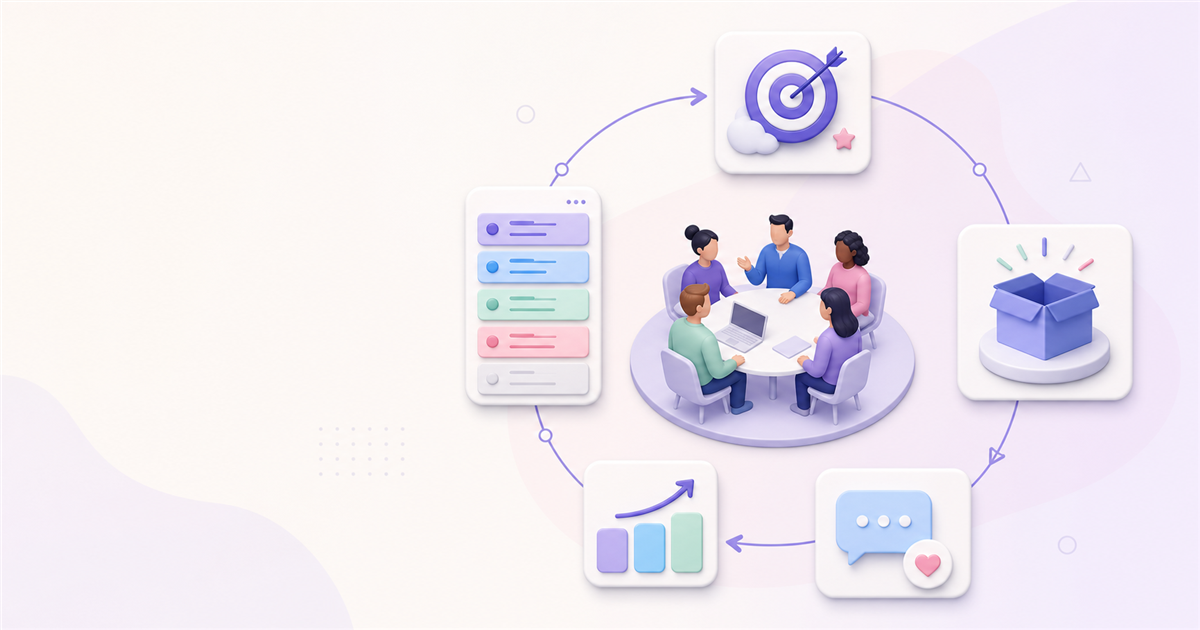
A useful visual model connects these elements rather than listing them independently. Product direction informs Sprint Planning, daily inspection adapts the Sprint Backlog, stakeholder feedback influences the Product Backlog, and the Retrospective improves how the team works.
Technical implementation notes
A process model needs an explicit scope, start and end events, actors, inputs, outputs, decisions, exceptions, and ownership. Use consistent symbols and verb-led activity labels, and separate the normal path from failures, retries, escalations, and manual review.
Validate the model by walking through real cases with the people who perform the work. Record assumptions, system boundaries, rule sources, version, owner, and review date so the diagram remains traceable instead of becoming an attractive but stale picture. The most relevant concepts here are what is Scrum, Scrum framework, Scrum visual guide. Define them when first used and apply each term consistently to an observable element, rule, or outcome.
- Every branch has a labeled condition
- Activities identify an action and responsible actor
- Exceptions and handoffs are visible
- The model has an owner and review trigger
Worked example: What Is Scrum? A Visual Guide to the Framework
Consider a Scrum Team improving account recovery. Connect the Product Goal to a Sprint Goal focused on reducing failed recovery attempts, select a small set of Product Backlog items, and make the Definition of Done visible beside the usable Increment rather than treating completion as a ticket status.
During the Sprint, inspect progress toward the goal, adapt the Sprint Backlog when an integration risk appears, and bring measured recovery results to the Sprint Review. Use the Retrospective to choose one owned improvement to the team's testing workflow, then show how that adaptation enters the next Sprint.
Conclusion
The path through scrum is a lightweight framework for complex work, transparency, inspection, and adaptation form the engine, one scrum team contains three accountabilities, and events inspect artifacts and adapt commitments brings the article back to one practical concern: how “What Is Scrum? A Visual Guide to the Framework” behaves outside an ideal example. The technical checks and worked scenario turn the guidance into something a reader can evaluate and apply.
In our view, Scrum works through transparent goals, usable Increments, frequent inspection, and real adaptation—not through mechanically scheduling meetings or enforcing optional practices as rules. A visual model should preserve those feedback loops and the self-management on which they depend.
Create the visual journey
Turn your process into a presentation
Build the diagram, choose the sequence, add narration or webcam video, and preview the camera movement in your browser.
Open Praebere