
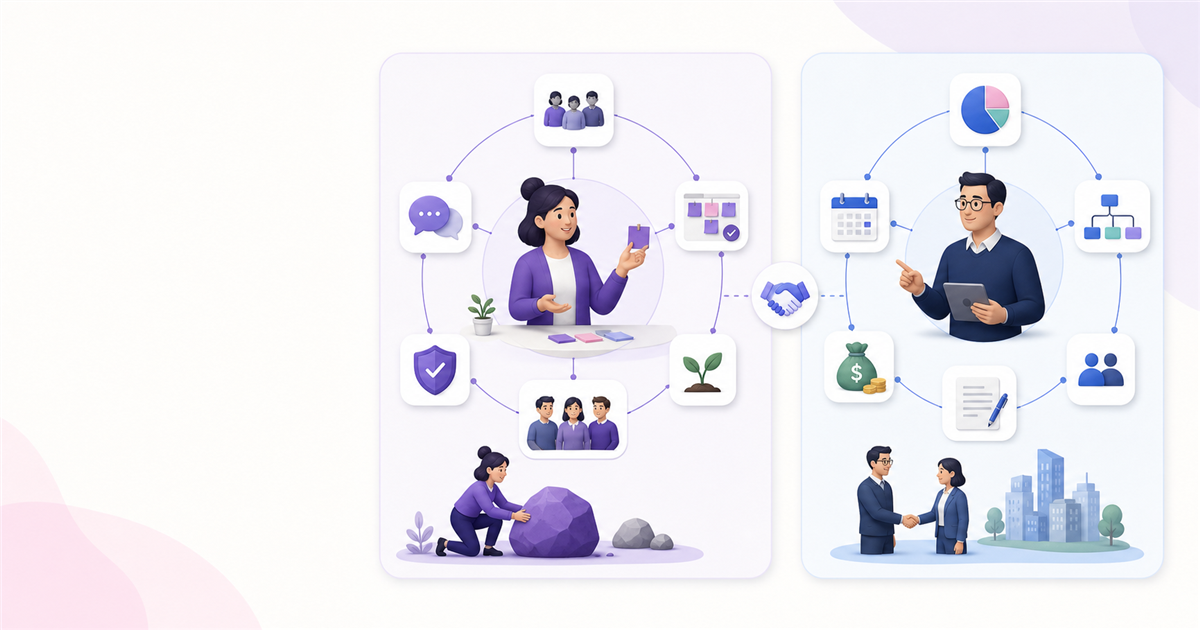
The right choice depends on the job
One issue sets the direction for “Scrum Master vs. Project Manager”: “The titles come from different management systems.” A process model needs an explicit scope, start and end events, actors, inputs, outputs, decisions, exceptions, and ownership.
The practical challenge begins when general advice meets real content, real constraints, and a real audience. Which Scrum element is being inspected, what commitment gives it purpose, and what evidence should cause the team to adapt? Is the practice supporting transparency and self-management, or has it become a reporting ritual disconnected from product value? The sections ahead use these questions to move from the central idea to concrete decisions, technical criteria, and an applied example.
The titles come from different management systems
The Scrum Master is an accountability defined by Scrum. The person helps establish the framework, coaches self-management and cross-functionality, supports removal of impediments, and improves the Scrum Team’s effectiveness within the wider organization.
Project Manager is a broader organizational role whose authority and duties vary. It can include scope, schedule, budget, resources, contracts, risks, reporting, and coordination across work that may or may not use Scrum.
The accountabilities can coexist when boundaries are explicit
Organizations may still need portfolio coordination, procurement, regulatory reporting, vendor management, or temporary-project responsibilities. A Project Manager can perform useful work around a Scrum Team without controlling its Sprint Backlog or replacing product accountability.
Map decisions and information flows instead of forcing a one-to-one title conversion. Clarify who owns product direction, team process, delivery plan, budget, external dependencies, people management, and organizational risk.
Choose the transition from capabilities, not titles
A Project Manager moving into Scrum Master work may bring facilitation, risk awareness, and organizational navigation, but may need to unlearn task assignment, status collection, and plan enforcement. Training alone is insufficient without a change in authority and expectations.
The right design is the one that makes accountabilities transparent and supports empiricism. Renaming positions while preserving conflicting decision structures produces confusion rather than agility.
Technical implementation notes
A process model needs an explicit scope, start and end events, actors, inputs, outputs, decisions, exceptions, and ownership. Use consistent symbols and verb-led activity labels, and separate the normal path from failures, retries, escalations, and manual review.
Validate the model by walking through real cases with the people who perform the work. Record assumptions, system boundaries, rule sources, version, owner, and review date so the diagram remains traceable instead of becoming an attractive but stale picture. The most relevant concepts here are Scrum Master vs project manager, Scrum roles, project management and Scrum. Define them when first used and apply each term consistently to an observable element, rule, or outcome.
- Every branch has a labeled condition
- Activities identify an action and responsible actor
- Exceptions and handoffs are visible
- The model has an owner and review trigger
Worked example: Scrum Master vs. Project Manager
Consider a Scrum Team improving account recovery. Connect the Product Goal to a Sprint Goal focused on reducing failed recovery attempts, select a small set of Product Backlog items, and make the Definition of Done visible beside the usable Increment rather than treating completion as a ticket status.
During the Sprint, inspect progress toward the goal, adapt the Sprint Backlog when an integration risk appears, and bring measured recovery results to the Sprint Review. Use the Retrospective to choose one owned improvement to the team's testing workflow, then show how that adaptation enters the next Sprint.
Conclusion
Seen as a whole, the sections on the titles come from different management systems, scrum distributes decisions that projects often centralize, the accountabilities can coexist when boundaries are explicit, and choose the transition from capabilities, not titles move from explanation to application. They show that “Scrum Master vs. Project Manager” depends on both a clear concept and disciplined execution.
In our view, Scrum works through transparent goals, usable Increments, frequent inspection, and real adaptation—not through mechanically scheduling meetings or enforcing optional practices as rules. A visual model should preserve those feedback loops and the self-management on which they depend.
Create the visual journey
Turn your process into a presentation
Build the diagram, choose the sequence, add narration or webcam video, and preview the camera movement in your browser.
Open Praebere