
The practical decisions behind “How to Communicate Risks and Opportunities”
The most useful entry point into “How to Communicate Risks and Opportunities” is not decoration, but the problem captured by “Use consistent definitions and time horizons.” Translate the communication goal into an audience action: understand, compare, decide, remember, or perform.
The practical challenge begins when general advice meets real content, real constraints, and a real audience. What precise decision does the audience need to make, and which evidence, uncertainty, tradeoffs, and consequences belong in that decision? Can leaders identify the requested action, owner, deadline, and conditions that would change the recommendation? The sections ahead use these questions to move from the central idea to concrete decisions, technical criteria, and an applied example.
Use consistent definitions and time horizons
Describe cause, uncertain event, and potential impact separately. Assess likelihood and impact with agreed scales, and show the time horizon because an urgent moderate risk may matter more than a distant severe one.
Avoid presenting opportunities as guaranteed upside. State dependencies, investment, evidence, and the conditions required to realize value.
Connect each item to a response
Identify mitigation or pursuit actions, owners, deadlines, early warning indicators, residual exposure, and escalation thresholds. Scenario ranges are often more honest than a single precise forecast.
Use color with text and symbols so meaning does not depend on red and green alone. Prioritize the few items that change a decision.
Use scenarios and examine portfolio effects
A risk matrix is a starting point, not the complete analysis. Build plausible scenarios that connect causes, events, consequences, time horizon, velocity, and recoverability. Where possible, estimate ranges and leading indicators. Describe uncertainty in plain language and avoid false numerical precision when evidence is weak.
Risks and opportunities can be correlated: one event may affect several objectives, and multiple small exposures can combine into a material outcome. Show dependencies, concentration, and the effect of existing controls. Prioritize items that are specific and material rather than presenting a generic catalog that could apply to any organization.
- Separate inherent exposure from residual exposure after controls
- Define indicators and escalation thresholds
- Model correlations and dependencies across the portfolio
- Assign action, owner, deadline, and review cadence
Technical implementation notes
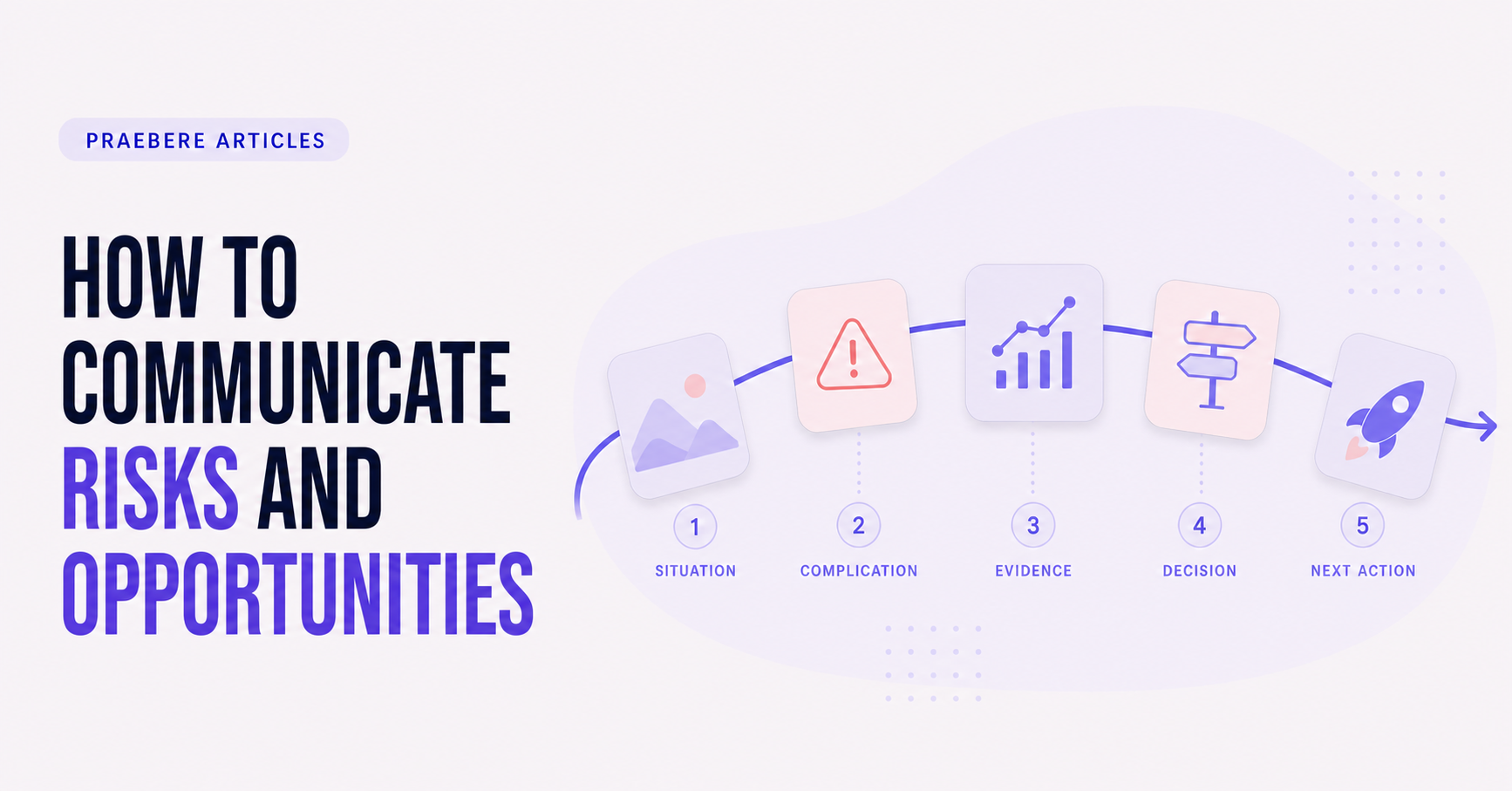
Translate the communication goal into an audience action: understand, compare, decide, remember, or perform. Build a claim-evidence-reasoning chain and distinguish observed facts, interpretation, assumptions, uncertainty, and recommendations.
Use progressive disclosure: context first, then the model, evidence, exceptions, and implications. Define unfamiliar terms, keep labels close to what they describe, and test whether a reader can reconstruct the intended logic without the presenter present. The most relevant concepts here are communicate risks, present opportunities, risk presentation. Define them when first used and apply each term consistently to an observable element, rule, or outcome.
- Audience and intended action are explicit
- Claims remain connected to evidence
- Assumptions and uncertainty are labeled
- Sequence ends with a clear implication or next step
Worked example: How to Communicate Risks and Opportunities
Suppose leadership must decide whether to fund a service expansion. Begin with the decision and strategic objective, then show the current baseline, expected range rather than a single-point promise, resource requirement, major dependencies, and comparable downside scenarios.
Separate committed results from forecasts, assign an owner to each risk response, and define the trigger that would change the recommendation. End with a precise ask—amount, authority, deadline, and next review—so the presentation can produce an accountable decision.
Conclusion
Seen as a whole, the sections on use consistent definitions and time horizons, connect each item to a response, and use scenarios and examine portfolio effects move from explanation to application. They show that “How to Communicate Risks and Opportunities” depends on both a clear concept and disciplined execution.
We believe the practical standard should be clear: business communication should connect evidence and uncertainty to a decision, owner, and next action. Concision is useful only when it preserves the context required to act responsibly.
Create the visual journey
Turn your process into a presentation
Build the diagram, choose the sequence, add narration or webcam video, and preview the camera movement in your browser.
Open Praebere