
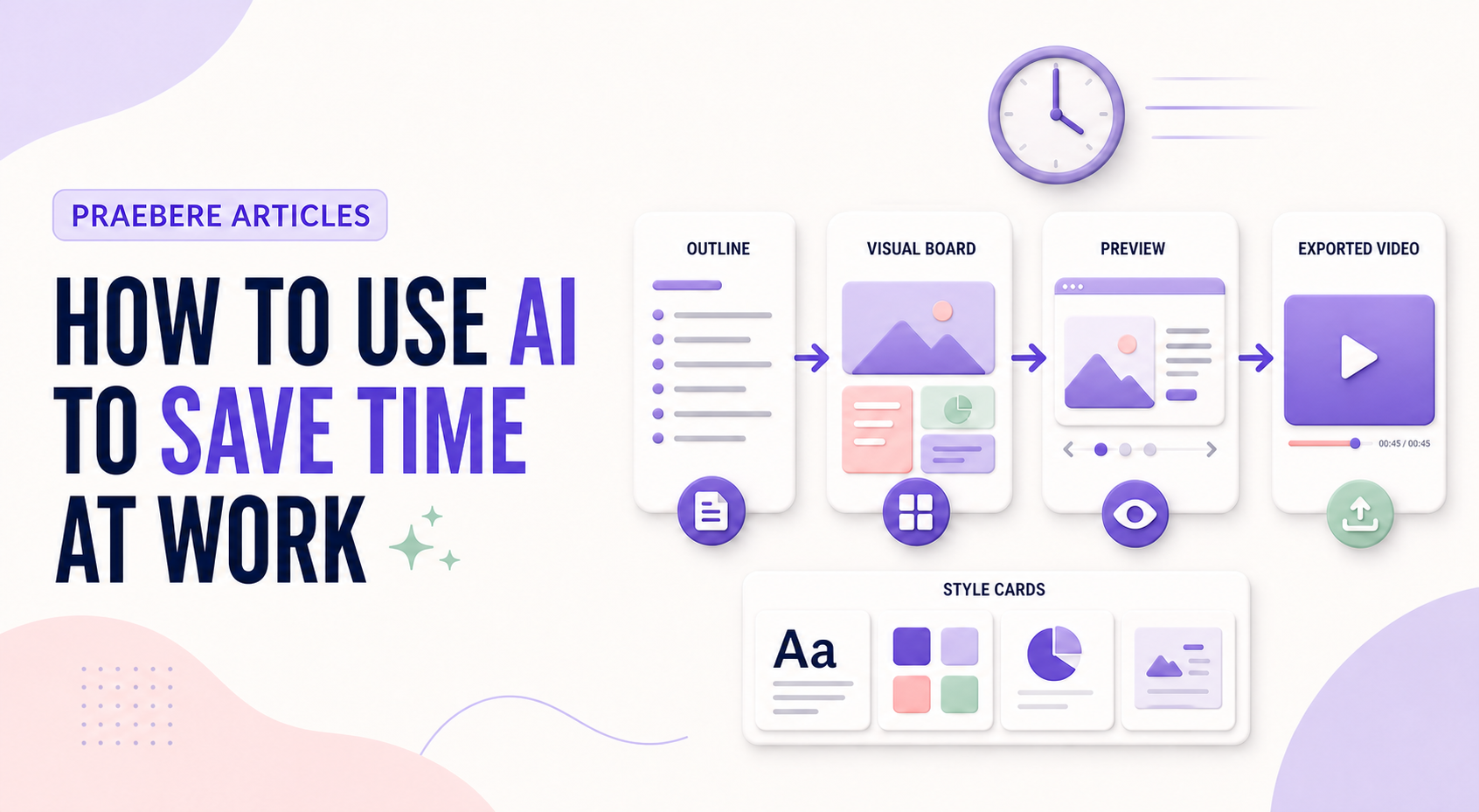
The practical decisions behind “How to Use AI to Save Time at Work”
The visible choices in “How to Use AI to Save Time at Work” grow from the earlier decision described by “Choose bounded, reviewable tasks.” Productivity comes from reusable decisions, not from skipping validation.
The practical challenge begins when general advice meets real content, real constraints, and a real audience. Which decisions can be reused or automated safely, and which facts still require human judgment? How will the team control sources, versions, permissions, accessibility, failures, and approval while trying to work faster? The sections ahead use these questions to move from the central idea to concrete decisions, technical criteria, and an applied example.
Choose bounded, reviewable tasks
External AI tools can help create a first draft, summarize material you are authorized to process, classify feedback, suggest alternatives, or turn notes into a checklist. Define the expected format and evidence before starting so the result can be checked.
Do not delegate accountability. Verify facts against primary sources, inspect calculations, remove invented citations, and apply professional judgment before the output affects a customer, employee, or decision.
Protect information and preserve authorship
Follow organizational policy and the provider’s data controls. Never submit confidential, personal, regulated, copyrighted, or client material without authorization. Keep a human approval step and disclose AI assistance when policy or context requires it.
Praebere does not use AI to generate or edit presentations. It is an author-directed visual editor: people create the content, diagram, sequence, styles, and narration, while the app turns that chosen sequence into camera movement, transitions, and exportable video.
Evaluate the tool, the task, and the resulting risk
Before using an external AI service, classify the task by consequence and reversibility. Brainstorming low-risk alternatives is different from producing legal, financial, medical, employment, or customer-facing decisions. Review the provider’s data use, retention, security, regional availability, and model limitations, and follow the organization’s approved-tool policy.
Keep the original source material and record the prompt, tool version when available, output, edits, reviewer, and decision for consequential work. Test representative and edge cases, look for unsupported claims or unfair patterns, and create a non-AI fallback. Saving drafting time is not valuable if verification, privacy exposure, or correction costs exceed the benefit.
- Use only authorized data and approved external services
- Match review rigor to impact, uncertainty, and reversibility
- Verify claims against primary sources and recalculate important numbers
- Praebere itself does not use AI to generate or edit presentations
Technical implementation notes
Productivity comes from reusable decisions, not from skipping validation. Separate content, data, style, media, and output configuration; standardize stable parts; and keep variable information linked to an identifiable source and owner.
Use templates, naming conventions, metadata, version history, and approval states. Automate only repeatable operations with defined inputs and outputs, then retain human review for factual accuracy, accessibility, permissions, and the final audience experience. The most relevant concepts here are use AI at work, AI productivity, save time with AI. Define them when first used and apply each term consistently to an observable element, rule, or outcome.
- Reusable assets have owners and versions
- Variable facts retain source and review date
- Automation logs inputs, outputs, and failures
- Approved output is distinguishable from drafts
Worked example: How to Use AI to Save Time at Work
Imagine a team producing a weekly operations update. Store an approved template with semantic layouts, connect each metric to a named source, assign owners for narrative and accessibility, and generate a dated draft from validated inputs while preserving version history.
Before release, a reviewer checks changed facts, broken links, overflow, reading order, and permissions. If automation fails halfway, the previous approved export remains available and the log identifies which input or operation failed.
Conclusion
The path through choose bounded, reviewable tasks, protect information and preserve authorship, and evaluate the tool, the task, and the resulting risk brings the article back to one practical concern: how “How to Use AI to Save Time at Work” behaves outside an ideal example. The technical checks and worked scenario turn the guidance into something a reader can evaluate and apply.
We believe the practical standard should be clear: speed and reuse create value only when sources, ownership, versions, accessibility, and approval remain controlled. Faster production should remove repetition, not remove judgment.
Create the visual journey
Turn your process into a presentation
Build the diagram, choose the sequence, add narration or webcam video, and preview the camera movement in your browser.
Open Praebere