
The right choice depends on the job
A reader can understand “Visual Storytelling vs. Traditional Slide Presentations” more clearly by first looking at “Two different models for organizing ideas.” Translate the communication goal into an audience action: understand, compare, decide, remember, or perform.
The practical challenge begins when general advice meets real content, real constraints, and a real audience. What question carries the audience from the opening to the conclusion, and why should the answer matter to them? How can context, evidence, tension, examples, and resolution form a coherent path without manipulating or oversimplifying the facts? The sections ahead use these questions to move from the central idea to concrete decisions, technical criteria, and an applied example.
Two different models for organizing ideas
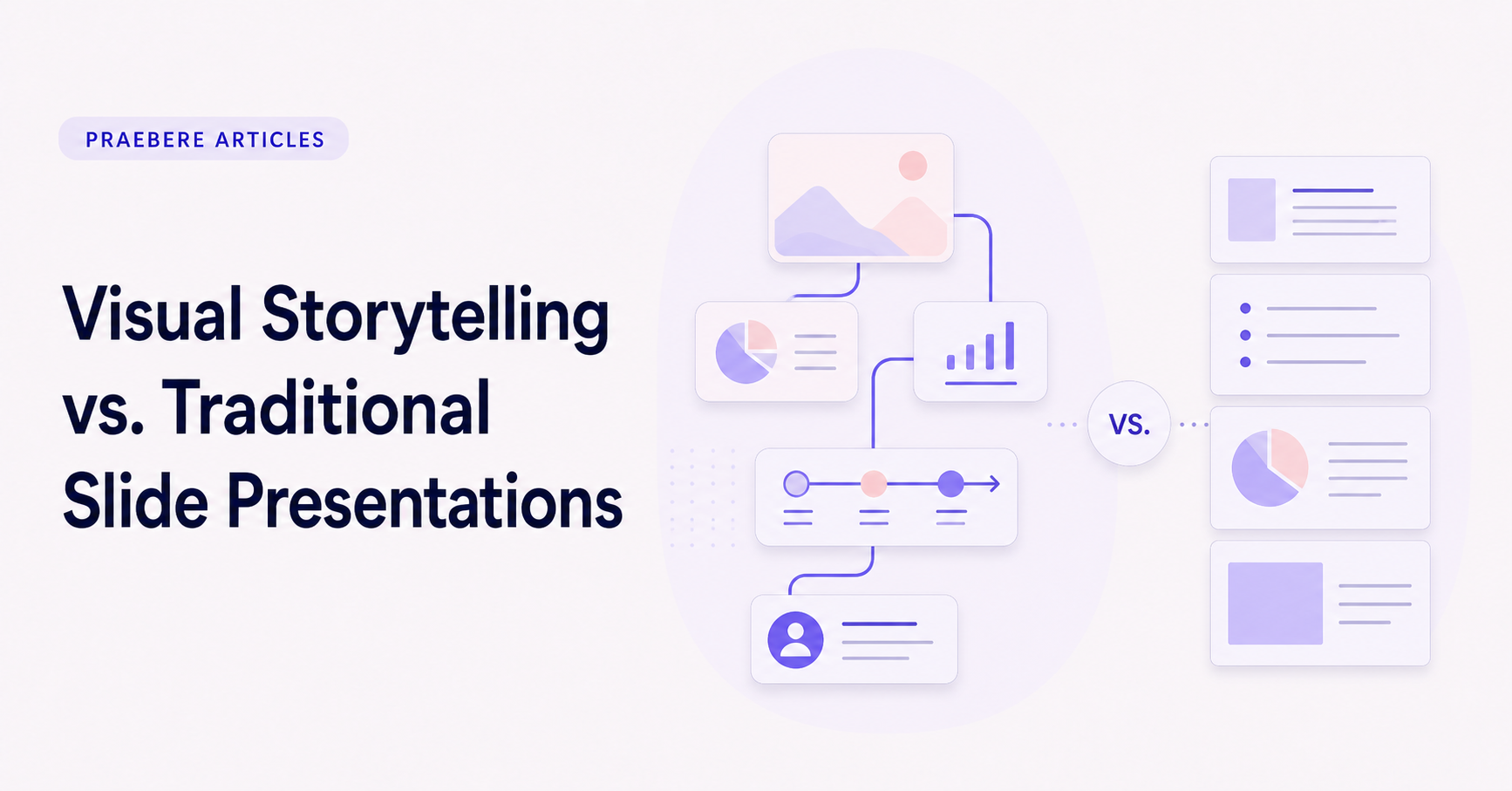
Traditional slides divide a message into separate frames. This is effective for a fixed agenda, a sequence of evidence, or content that benefits from a clean reset between topics.
Spatial visual storytelling places ideas on one connected surface. The camera moves between related areas, allowing the audience to see both detail and context. It is particularly effective for systems, processes, relationships, and branching decisions.
When slides are the better choice
Use slides when each section stands on its own, when the audience expects printable pages, or when charts and quotations need consistent full-frame treatment. Slides also work well with familiar corporate templates.
The weakness appears when a connected process is broken into frames and the audience must remember how earlier pieces relate to the current one.
When spatial storytelling is stronger
A connected canvas can show hierarchy, direction, cause, and alternatives without repeatedly reconstructing context. Zoom reveals detail while the layout preserves the larger mental map.
Spatial storytelling still needs a sequence. Without deliberate camera movement and narration, a large canvas can become an overwhelming poster.
Use a hybrid structure when needed
A visual process can include slide-like containers for chapters, examples, or summary frames. This combines the clarity of a bounded layout with the continuity of a connected map.
Choose the structure based on the content rather than the novelty of the effect. A simple list should not become a complicated diagram, and a branching system should not be forced into disconnected slides.
Build the story around relationships
Praebere uses an open board, ordered elements, camera framing, and animated connectors to turn relationships into a presentation path. It is best suited to messages where the connections are part of the explanation.
Before choosing any tool, write the main question your audience should answer. If the answer depends on seeing how ideas connect, visual storytelling is likely the stronger model.
Technical implementation notes
Translate the communication goal into an audience action: understand, compare, decide, remember, or perform. Build a claim-evidence-reasoning chain and distinguish observed facts, interpretation, assumptions, uncertainty, and recommendations.
Use progressive disclosure: context first, then the model, evidence, exceptions, and implications. Define unfamiliar terms, keep labels close to what they describe, and test whether a reader can reconstruct the intended logic without the presenter present. The most relevant concepts here are visual storytelling presentation, nonlinear presentation, slide presentation alternative. Define them when first used and apply each term consistently to an observable element, rule, or outcome.
- Audience and intended action are explicit
- Claims remain connected to evidence
- Assumptions and uncertainty are labeled
- Sequence ends with a clear implication or next step
Worked example: Visual Storytelling vs. Traditional Slide Presentations
Consider a proposal to reduce customer wait time. Open with the current customer journey and measured delay, explain the operational bottleneck, compare two credible interventions, and reveal the recommendation only after the decision criteria and evidence are visible.
Keep observed data separate from interpretation and state the assumptions behind the forecast. The ending should resolve the opening question with an owner, next action, and measure of success, so narrative structure supports a real decision rather than manufacturing suspense.
Conclusion
Rather than reducing “Visual Storytelling vs. Traditional Slide Presentations” to a checklist, the article linked two different models for organizing ideas, when slides are the better choice, when spatial storytelling is stronger, use a hybrid structure when needed, and build the story around relationships. That combination explains not only what to do, but also why the choices matter and how to inspect the outcome.
Our editorial position is straightforward: storytelling in presentations should clarify the path from context to resolution, not manufacture suspense. Narrative earns its place when it helps the audience understand why the evidence matters and where it leads.
Create the visual journey
Turn your process into a presentation
Build the diagram, choose the sequence, add narration or webcam video, and preview the camera movement in your browser.
Open Praebere