
The right choice depends on the job
Good intentions are not enough for “Decorative vs. Informative Animation in Presentations”; the result depends on how the author handles “Decorative and informative motion do different jobs.” Motion should encode a change in state, sequence, hierarchy, or spatial relationship.
The practical challenge begins when general advice meets real content, real constraints, and a real audience. What information does the movement reveal that a static frame cannot show as clearly? Where should the eye land, how long does orientation take, and what happens for viewers who prefer or require reduced motion? The sections ahead use these questions to move from the central idea to concrete decisions, technical criteria, and an applied example.
Decorative and informative motion do different jobs
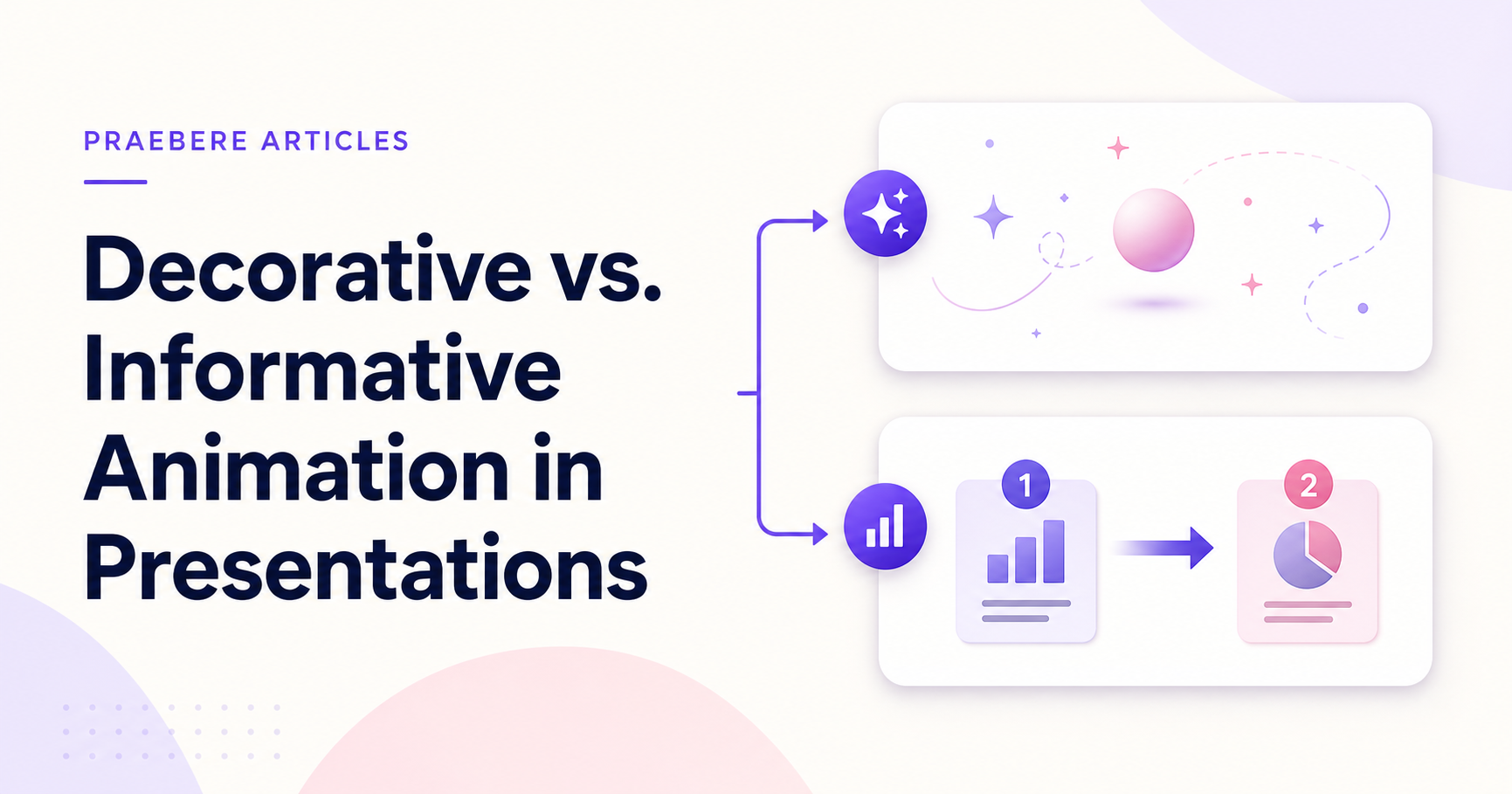
Decorative animation changes how a presentation feels. It can add energy, reinforce a visual identity, or make an entrance more polished. Informative animation changes what the audience can understand. It reveals an order, shows a relationship, explains a change, or directs attention to the part of a visual that matters now.
The distinction depends on purpose rather than on the effect itself. A fade may be decorative when it is applied to every title, but informative when it reveals the next item in a sequence and prevents the audience from reading ahead. A camera move may be ornamental when it travels without a reason, but explanatory when it follows a process connector to the next step.
Ask what information the movement carries
A useful test is to remove the animation and ask what becomes harder to understand. If the audience loses the order of events, the direction of a process, the connection between two states, or the location of a detail, the motion is carrying information. If nothing about the meaning changes, the animation is probably decorative.
Informative animation commonly supports sequence, cause and effect, hierarchy, comparison, spatial orientation, and state change. It should make the intended interpretation easier, not merely make the slide busier.
- Reveal steps in the order they should be read.
- Move along a path to show direction or handoff.
- Preserve stable elements while a state changes.
- Zoom from an overview to a relevant detail.
Decorative animation is not automatically a problem
A small amount of decorative motion can establish tone, create rhythm, or make a section opening feel distinct. It becomes a problem when it competes with reading, delays access to content, or creates visual signals that the presentation never explains.
Treat decoration as a supporting layer. Keep it brief, consistent, and quieter than the motion used to communicate structure. If every element bounces, rotates, or arrives from a different direction, the audience cannot distinguish emphasis from ornament.
Build a small and consistent motion system
Define a limited set of motion rules before animating individual screens. One behavior can reveal content, another can move between related ideas, and a third can mark a major chapter change. Repetition allows the audience to learn what each movement means.
Keep duration, direction, and scale proportional to the message. Short local changes should use restrained motion, while a genuine shift from overview to detail may justify a larger camera move. Always leave enough stable time after movement for the audience to read and interpret the destination.
Use animation to guide a connected visual story
A connected board provides natural reasons for movement. Lines define direction, groups establish chapters, and the distance between elements can indicate whether the view should pan, zoom, or remain still. Start from that structure instead of adding effects after the story is complete.
Praebere lets you order elements, animate connectors, control camera framing, and add voice or webcam video. Use those controls to reveal relationships and guide attention. Decorative polish can remain subtle, while the informative movement does the essential work of explaining the sequence.
Technical implementation notes
Motion should encode a change in state, sequence, hierarchy, or spatial relationship. Specify the start state, end state, duration, easing curve, trigger, and what the audience should notice; otherwise animation becomes decoration rather than information.
Preserve object continuity and avoid simultaneous competing motion. Preview at normal speed, support reduced-motion preferences where the delivery format allows it, and confirm that the same meaning remains available in a static frame, transcript, or alternative explanation. The most relevant concepts here are decorative animation, informative animation, presentation motion design. Define them when first used and apply each term consistently to an observable element, rule, or outcome.
- One attentional target at a time
- Stable spatial continuity between states
- Duration matches the amount of information revealed
- Static or reduced-motion alternative preserves meaning
Worked example: Decorative vs. Informative Animation in Presentations
Picture a five-step incident-response diagram. Keep the complete map stable, then move the camera to the active node over roughly the time needed to orient the viewer. Reveal the outgoing connector only when explaining the handoff, and pause before changing direction at a decision.
Compare the animated version with a static overview. If movement does not clarify sequence, state change, or spatial relationship, remove it. Also preview a reduced-motion treatment using cuts or gentle fades so the explanation does not depend on sweeping zooms.
Conclusion
Taken together, decorative and informative motion do different jobs, ask what information the movement carries, decorative animation is not automatically a problem, build a small and consistent motion system, and use animation to guide a connected visual story show that “Decorative vs. Informative Animation in Presentations” is not an isolated technique. The article connected its central principles to implementation details and a practical case, making the tradeoffs easier to see.
Our editorial position is straightforward: movement deserves a place only when it explains sequence, continuity, state, causality, or emphasis. Restrained informative motion strengthens an explanation; purposeless motion taxes attention.
Create the visual journey
Turn your process into a presentation
Build the diagram, choose the sequence, add narration or webcam video, and preview the camera movement in your browser.
Open Praebere