
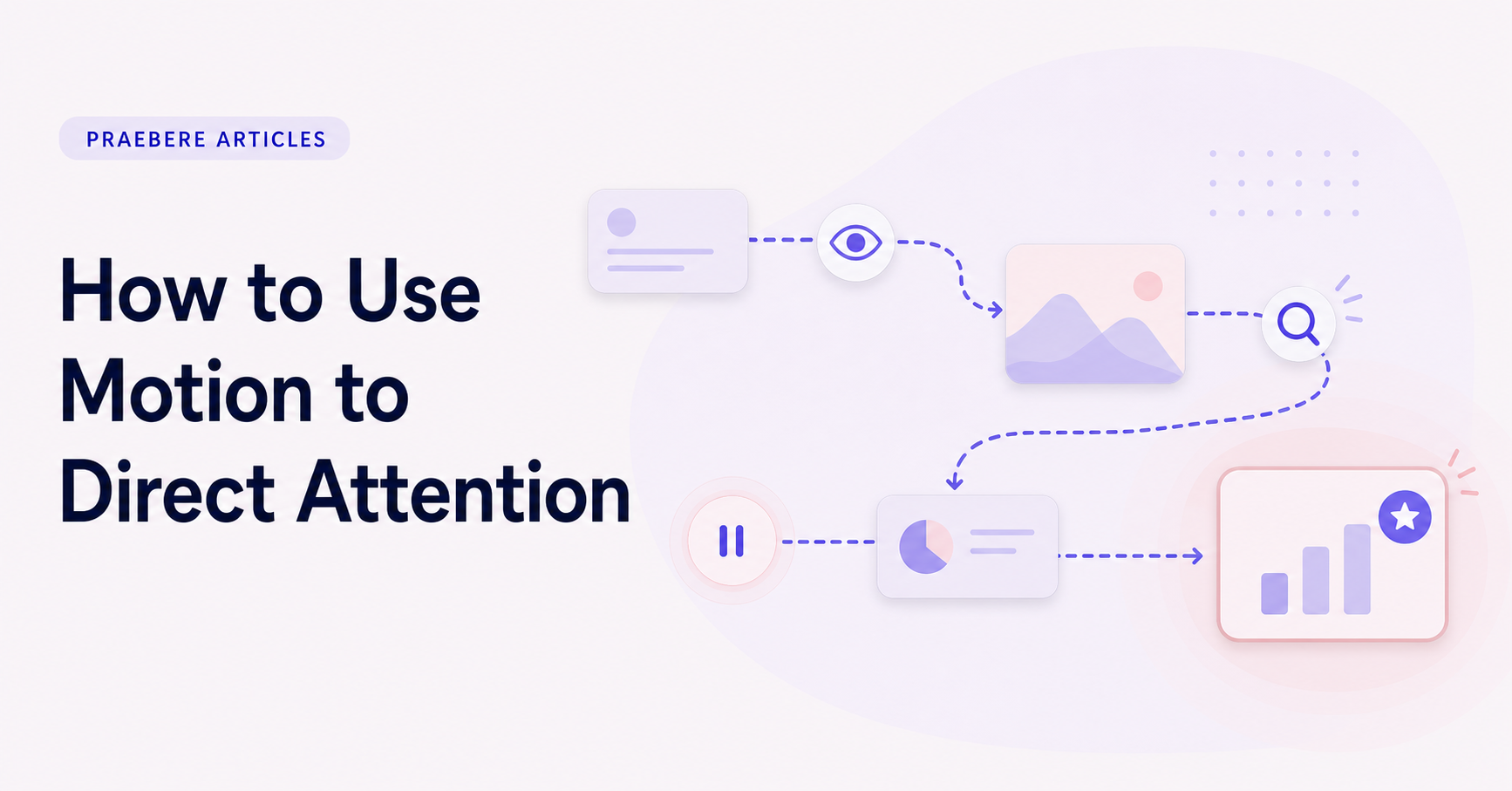
The practical decisions behind “How to Use Motion to Direct Attention”
The work behind “How to Use Motion to Direct Attention” starts with a practical concern captured by “Movement naturally competes for attention.” Motion should encode a change in state, sequence, hierarchy, or spatial relationship.
The practical challenge begins when general advice meets real content, real constraints, and a real audience. What information does the movement reveal that a static frame cannot show as clearly? Where should the eye land, how long does orientation take, and what happens for viewers who prefer or require reduced motion? The sections ahead use these questions to move from the central idea to concrete decisions, technical criteria, and an applied example.
Movement naturally competes for attention
A moving element is likely to draw the eye before a static one. This makes motion useful for directing focus, but it also means accidental movement can overpower the intended message. Decide what the audience should notice before choosing an effect.
Use one dominant movement at a time. When several objects move independently, the audience must choose where to look and may miss the relationship the animation was meant to explain.
Match the motion technique to the attention goal
A reveal introduces information that was not previously visible. A change in scale can emphasize one element while preserving context. A camera move connects two locations, and a short highlight can return attention to an object already on screen.
Choose the smallest motion that communicates the change. If color or position already makes the priority clear, additional animation may not improve the result.
- Reveal for new information.
- Zoom for detail within a larger context.
- Pan for spatial relationships.
- Highlight for renewed emphasis.
Prepare the audience before the movement
Attention is easier to guide when the current frame is stable and readable. Establish the context, then begin the movement. If the camera starts moving before the audience understands the starting point, the transition can feel disorienting.
Narration can signal what to watch for, but timing matters. The relevant element should arrive just before or as it is discussed. Describing something long before it appears forces the audience to hold an incomplete reference in memory.
Allow time after the motion ends
Movement directs the eye; the pause afterward allows understanding. Hold the destination long enough for labels, data, or relationships to be read. Important decisions and complex diagrams need more viewing time than simple transition frames.
Avoid continuous motion that never settles. A sequence of clear states connected by purposeful transitions is usually easier to follow than a presentation in which every element remains animated.
Direct the camera through a diagram
Plan the route according to the explanation, not merely the physical position of shapes. Follow connectors when they express the relationship, pause at decisions, and use wider views when multiple branches need to be compared.
In Praebere, the order and zoom you assign to elements define that attention path. Preview the sequence with narration or webcam video, then remove camera changes that do not clarify the story. The strongest motion is the movement the audience understands without having to notice it as an effect.
Technical implementation notes
Motion should encode a change in state, sequence, hierarchy, or spatial relationship. Specify the start state, end state, duration, easing curve, trigger, and what the audience should notice; otherwise animation becomes decoration rather than information.
Preserve object continuity and avoid simultaneous competing motion. Preview at normal speed, support reduced-motion preferences where the delivery format allows it, and confirm that the same meaning remains available in a static frame, transcript, or alternative explanation. The most relevant concepts here are motion directs attention, presentation motion, animation focus. Define them when first used and apply each term consistently to an observable element, rule, or outcome.
- One attentional target at a time
- Stable spatial continuity between states
- Duration matches the amount of information revealed
- Static or reduced-motion alternative preserves meaning
Worked example: How to Use Motion to Direct Attention
Picture a five-step incident-response diagram. Keep the complete map stable, then move the camera to the active node over roughly the time needed to orient the viewer. Reveal the outgoing connector only when explaining the handoff, and pause before changing direction at a decision.
Compare the animated version with a static overview. If movement does not clarify sequence, state change, or spatial relationship, remove it. Also preview a reduced-motion treatment using cuts or gentle fades so the explanation does not depend on sweeping zooms.
Conclusion
Taken together, movement naturally competes for attention, match the motion technique to the attention goal, prepare the audience before the movement, allow time after the motion ends, and direct the camera through a diagram show that “How to Use Motion to Direct Attention” is not an isolated technique. The article connected its central principles to implementation details and a practical case, making the tradeoffs easier to see.
Our judgment after considering the full article is that movement deserves a place only when it explains sequence, continuity, state, causality, or emphasis. Restrained informative motion strengthens an explanation; purposeless motion taxes attention.
Create the visual journey
Turn your process into a presentation
Build the diagram, choose the sequence, add narration or webcam video, and preview the camera movement in your browser.
Open Praebere